
The monument · Last reviewed 6 September 2026
For foreign visitors, the upper gallery is the heart of the Hagia Sophia experience. This elevated walkway offers the best overall views of the vast interior, the legendary dome and the most important surviving Byzantine mosaics. Understanding what you can see from it, and what each element means, turns a simple visit into a richer encounter with nearly fifteen centuries of history.
The upper gallery was originally designed in the sixth century as a space for women, for the imperial court and for certain ceremonial functions. Today it serves as the main sightseeing route, letting visitors look down into the nave while remaining separate from the active prayer area below.
The central dome
The first and most overwhelming sight from the gallery is the immense central dome. Completed in 537 under Emperor Justinian I and later rebuilt after partial collapses, it spans about 31 metres in diameter and rises more than 55 metres above the floor. Its weight is carried by four massive piers and a complex system of pendentives and semi-domes — an engineering achievement that made Hagia Sophia the largest cathedral in the world for nearly a thousand years. From the gallery the dome appears to float, an effect the original architects deliberately sought by flooding it with light from the ring of windows at its base.
The nave and the interior space
Looking down from the upper gallery, visitors take in the full scale of the nave. This vast open space, framed by arcades of columns and marble-clad walls, was designed to inspire awe and to accommodate large liturgical processions. The interplay of light filtering through the windows and reflecting off polished marble still creates the luminous atmosphere that medieval writers described as almost heavenly. This view from above remains one of the most powerful ways to grasp the architectural ambition of Justinian’s great church.
Byzantine mosaics
Several of the finest surviving mosaics are best appreciated from the gallery level. The Deesis mosaic, in the south gallery, is among the most celebrated. Dating to the late thirteenth century, it shows Christ Pantocrator flanked by the Virgin Mary and John the Baptist in a scene of intercession. The refined, emotional faces and delicate modelling make it one of the masterpieces of late Byzantine art.
In the apse, the mosaic of the Virgin and Child — the Theotokos — sits high above the sanctuary. Installed in the ninth century after the end of Iconoclasm, it reasserted the legitimacy of religious images and became a powerful symbol of the restored Orthodox tradition.
Other important mosaics visible from or near the gallery include imperial portraits and the famous mosaic above the Imperial Door, showing an emperor traditionally identified as Leo VI prostrating before Christ. Together these works illustrate the long continuum of Byzantine imperial and religious imagery that once covered much of the interior.
Ottoman additions
After the conquest of 1453, Hagia Sophia was converted into a mosque and several Ottoman features were introduced. From the upper gallery these later additions are clearly visible and form an essential part of the building’s layered history.
Large calligraphic medallions bearing the names of Allah, the Prophet Muhammad, the first four caliphs and the grandsons of the Prophet hang high on the piers. Created in the nineteenth century by the master calligrapher Kazasker Mustafa İzzet Efendi, they dominate the visual field and mark the building’s centuries of use as a mosque.
The mihrab, the prayer niche indicating the direction of Mecca, and the minbar, the pulpit, stand in the apse area. Although the original Christian sanctuary orientation was slightly adjusted, these elements remain central to the mosque’s liturgical function. The sultan’s loge — an elevated screened box — is also visible from parts of the gallery and recalls the presence of Ottoman rulers during Friday prayers.
Marble, columns and architectural details
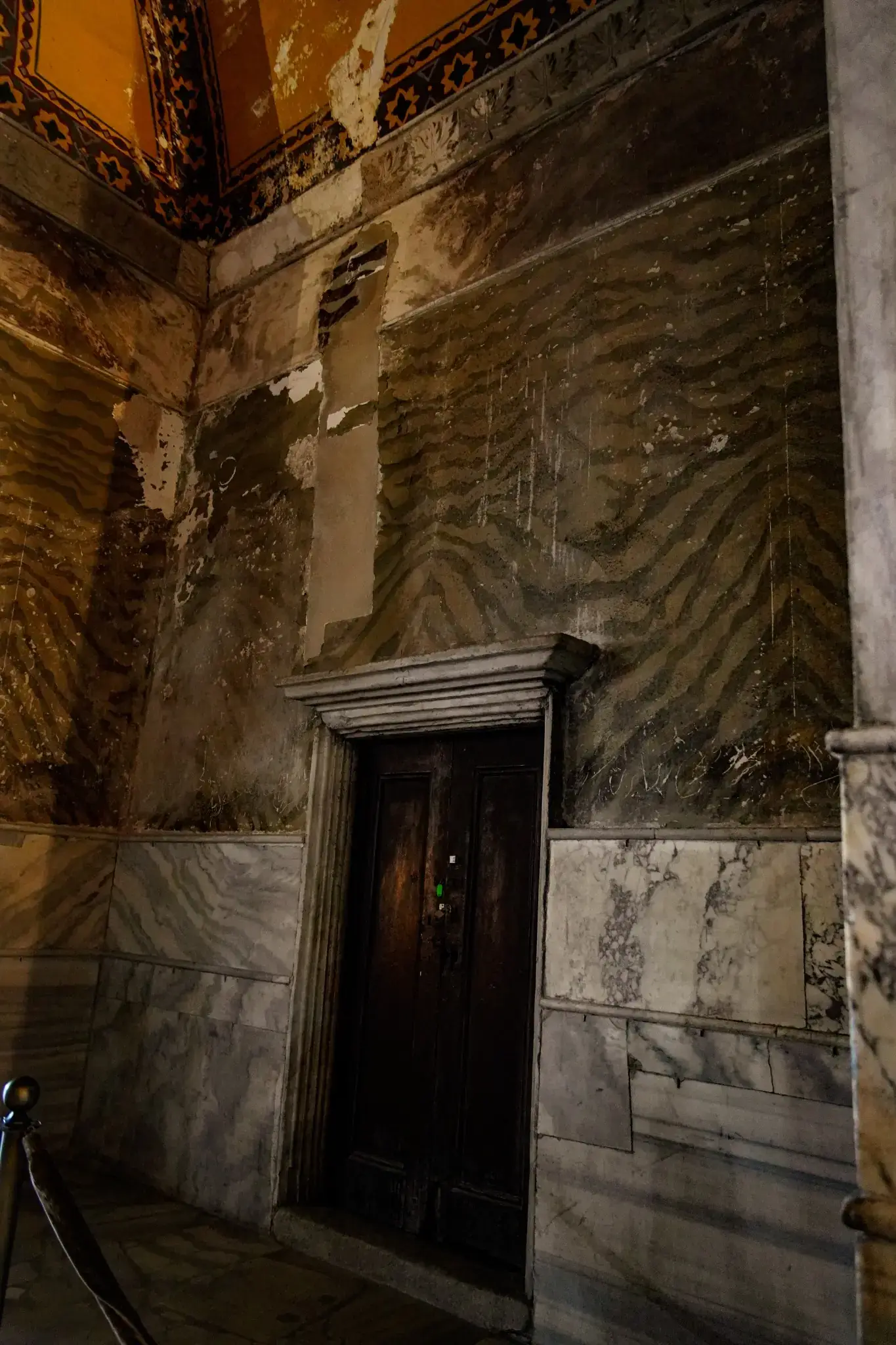
The gallery itself is lined with fine marble revetments and offers close views of the columns and capitals that support the structure. Many of the green and purple marble columns were brought from older Roman buildings across the empire, a practice of architectural reuse common in Justinian’s time. Looking carefully, visitors can observe the variety of capitals and the careful matching of materials that contribute to the harmony of the interior.
Light and atmosphere
One of the most memorable aspects of the upper gallery is the quality of the light. The original designers used dozens of windows at different levels to create a sense of dematerialised space. Even today, as light shifts across the marble and the mosaics, the interior changes character throughout the day. This carefully engineered luminosity remains one of the building’s greatest achievements.
Making the most of the upper gallery
A typical visit along the gallery lasts between forty-five and ninety minutes. Moving slowly allows time to study the mosaics, appreciate the scale of the dome and observe the dialogue between the Byzantine and Ottoman layers. Because the gallery provides the only elevated viewpoint available to most tourists, it is the single best place to understand both the architectural genius and the long historical journey of Hagia Sophia.
From the floating dome and the luminous nave to the surviving mosaics and the later Ottoman calligraphy, everything visible from the upper gallery tells part of a continuous story that began in the sixth century and continues into the present.